
Transformer RC snubbers and switching overvoltages
Energizing or de-energizing a transformer can produce insulation stress different from normal operating voltage. The breaker, connecting cable and transformer must be assessed together.
Why assess the breaker and transformer together?
Eaton’s technical publication identifies current chopping, reignition, short cable or bus connections, lightly loaded transformers and winding configuration as factors affecting transient severity. Transformer kVA alone cannot describe this interaction.
The role of an RC snubber
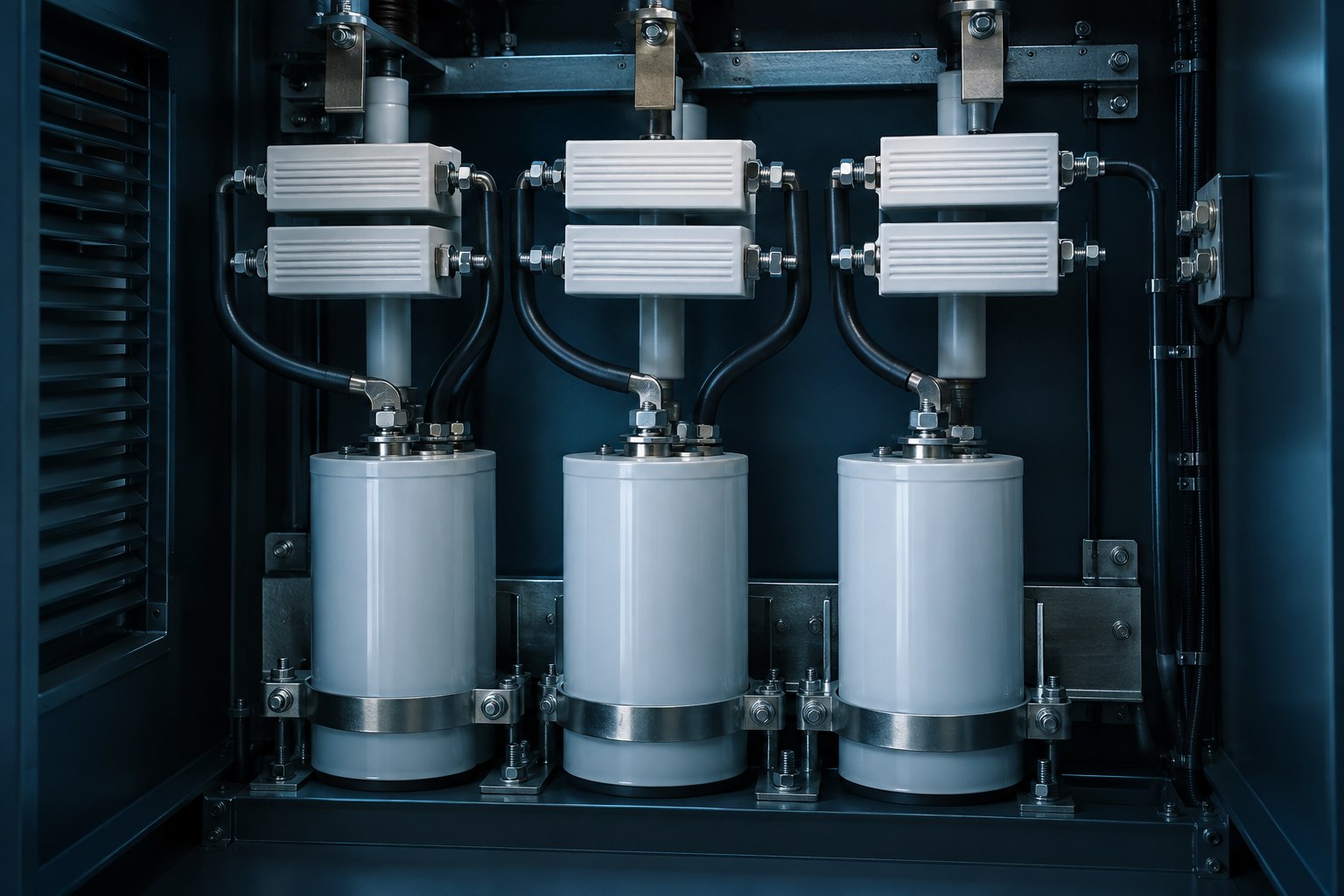
A properly designed RC snubber can help damp high-frequency transients. Voltage withstand, pulse energy, protection and installation must be assessed for the particular application. The RC branch and other surge-protection devices should not be assumed to perform identical functions.
Information needed for a study
Start with the single-line diagram, transformer voltages and winding connection, insulation data, breaker type, and cable length and characteristics. A system model is used to evaluate switching scenarios. The proposed solution follows from comparing transient voltages with equipment withstand capability.
Does every transformer need one?
There is no universal yes. A system study establishes the risk and suitable mitigation. Eaton’s published example selected the solution after switching-transient analysis and verified it with measurements after installation.
This is not a medium-voltage wiring or installation guide. Qualified engineers must assess insulation coordination and manufacturer data.
Eaton — Transformer switching transients, WP202001EN ↗
Eaton — Switching transient study and snubbers ↗
This content provides general information. Electrical installation work requires assessment by qualified technical personnel.
Explore this topic for your installation.
Share your existing system and technical question to discuss consulting.
Request a technical assessment ↗